

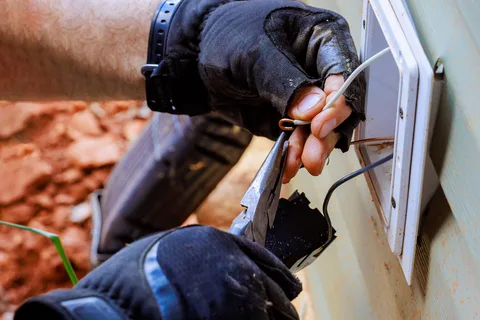
An electrical equipment insurance policy, written as contractors equipment, covers the movable tools, test gear and materials your business owns, on the jobsite, in transit and in storage. It answers theft, vandalism, fire and accidental physical damage, and it is not a repair plan.
What does an electrical equipment insurance policy cover?
It covers property that moves with the work. Think of the testers and meters in a case, the benders and knockout sets in the van, the cable pullers and wire spools, the generators, and the scissor and material lifts a crew rolls onto a site. The policy follows that property wherever it goes, which is why it fits a trade that moves between shop and job all day.
The line is called contractors equipment and sits in a category called inland marine, an older term for property in motion. Our contractors equipment page explains how the line is built, including the schedule, the blanket limit and how a loss is valued. This post is the buyer’s checklist for the gear itself.
Which tools and test gear should the policy list?
Start by sorting the gear into groups, since each group is handled a little differently:
- Test instruments. Multimeters, clamp meters, insulation testers and the other instruments a technician carries. They are the highest-value items that fit in a hand case, and the easiest to lose.
- Powered and shaping tools. Conduit benders, knockout sets and cable pullers.
- Large equipment. Generators and the scissor and material lifts that ride on a trailer.
- Smaller hand tools. The bulk of the bags and boxes.
- Material and fixtures. Wire on reels, panels and fixtures staged for the next install.
A schedule lists higher-value items one by one at agreed values, and a blanket limit covers the smaller tools as a group. Ask the agent which of your items belong on the schedule, and give the list in writing so there is a record of what was declared.
Test instruments deserve extra care because they are small, valuable and carried from site to site. A technician’s clamp meter can ride in a pocket, a tool bag and a different truck in the same week. If the policy lists instruments by item, record the make, the model and where it is kept, and update the list when instruments are replaced or added. A schedule that no longer matches the case in the van does not describe what you own.
Does an equipment policy pay for test equipment repair?
That is a question to ask, not one to assume. Contractors equipment responds to the events the policy names, such as theft, vandalism, fire and accidental physical damage. A tester dropped from a ladder is a different event from a tester that wears out or drifts out of calibration, and policies draw that line in their wording.
So put three questions to the agent. Is accidental damage to a tester or meter covered? Are wear, malfunction and mechanical breakdown excluded? And is calibration or routine service part of any covered loss? Read the answers in the policy form itself, and keep the policy separate from the manufacturer’s service arrangements, which are a different matter. We would rather tell you what the policy leaves out before you buy it than after a meter fails.
How are materials different from tools?
Materials are property you own but do not keep for long. Wire, panels, switchgear and fixtures arrive, get staged and then get installed, and while they wait they can be in the shop, in the yard, on a trailer or on the job. Where they are decides which policy answers a loss.
Material at a fixed location, such as your shop or storage, is a commercial property question. Material that travels, or that is staged at a jobsite for an upcoming install, leans on the equipment line. Our post on copper theft and property coverage walks that seam in detail, because copper is where electrical contractors feel it most. The commercial property page covers the other side, the shop and the stock kept in it.
Rented and borrowed gear needs its own check. Electrical crews rent lifts, borrow a bender from another crew and lease equipment for a season. The policy that covers the gear you own may not be written to cover the gear you do not, and a rental agreement can make you responsible for the equipment while it is in your hands. Read the rental agreement, ask the agent whether rented or borrowed equipment is covered under your policy and under what conditions, and decide before the rental whether to add it.
What decides how an equipment loss is settled?
Two things matter. One is the valuation basis, whether the policy settles at actual cash value or at replacement cost, and the contractors equipment page explains the difference. The other is the limit structure: the agreed values on the schedule, the blanket limit for smaller tools, and any per-item cap.
If a policy settles at actual cash value, an older tester is paid at its value after age and wear, which may not buy a new one. If you want the loss to buy a replacement, ask for replacement cost and confirm it in the wording. Neither choice is wrong, but the gap between them should be a decision you made, not a surprise at claim time.
Where does the gear have to be to be covered?
The policy follows the gear on the jobsite, in transit and in storage. That includes the van or truck, which is why the equipment policy and the commercial auto policy work together: auto covers the vehicle, and equipment covers the gear inside it. Our post on trucks, testers and wire shows how the split works when a vehicle is stolen with the gear in it.
Check the policy for conditions on storage, such as whether gear left in an unattended vehicle is treated differently. Wording on that point varies by policy, and it is a good question for the agent before it becomes a claim question.
Real-World Scenario: A technician leaves a case of test instruments and a cable puller in a locked van at a jobsite overnight. Thieves break in and take both. The van’s damage is a commercial auto physical damage claim. The instruments and the puller are an equipment claim, and how it is settled depends on whether they were listed on the schedule and whether the policy pays actual cash value or replacement cost. The owner, who listed the instruments by item and chose replacement cost, replaces them at the settled amount instead of arguing about what the old meters were worth.
How does the equipment policy interact with the rest of the program?
Equipment is one line among several, and its edges are worth knowing. The trucks that carry the gear run through commercial auto, which our post on work trucks explains, the shop and stock that stay put run through property, and the harm your work does to other people runs through general liability. The coverage overview shows the whole set, and each line answers a different question.
When a loss touches more than one line, such as a break-in that damages a van and takes the gear inside it, the claims run side by side. A clear schedule on the equipment policy and a clear vehicle list on the auto policy keep them from overlapping or leaving a gap.
What should you do after an equipment loss?
Act quickly and keep records. Report a theft to the police and get the report number, photograph any damage, and write down what was lost with the make, model and place it was taken from. Then call your agent before you replace anything, so the claim can be set up while the evidence is fresh. A schedule and a purchase record turn a long argument about what was in the case into a short list.
Keep the list somewhere other than the van. A list that burns or is stolen with the gear does nothing for the claim.
How should you prepare an equipment list for a quote?
Walk the van and the shop with a notepad. Record the make and model of each higher-value item, note where it is kept, and flag the lifts and generators that ride on a trailer. Then write down the material you stage and where you stage it. A list built this way gives the agent what it needs to start. When a loss does happen, our step-by-step guide on filing a claim for damaged electrical test equipment picks up from here.
What is the next step?
Send your equipment list with a quote request and tell us which items travel and which stay at the shop. We will ask where the gear is kept and how it is moved, and we explain how the equipment, property and auto lines divide the exposure. The coverage overview shows how the lines connect.