

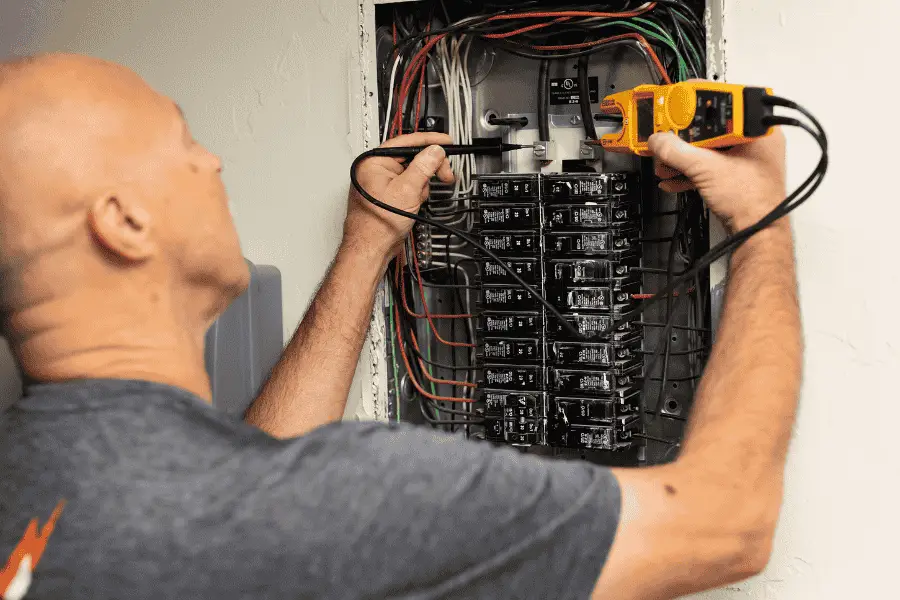
Every electrical job rolls out on wheels and carries a bed of gear: a service van or bucket truck, plus the testers, meters, benders, wire, and lifts riding with it. When a wreck, a theft, or a break-in hits, the vehicle and the gear inside it answer to two different lines — and neither is the on-site general liability that covers the work itself.
The short version: your service vans and trucks run through commercial auto, and your testers, meters, benders, wire, and lifts run through contractors equipment, an inland marine line. Both are distinct from the electrical work itself, which runs through general liability. This post walks the on-road-versus-on-jobsite split — including where a bucket truck lands — so you can see where each line starts and stops. Those coverage pages own the full architecture; this post is about how the two lines fit together on a working electrical operation.
Two lines, not one: what you drive versus what you carry
The cleanest way to hold this is to picture a service truck pulling up to a job. The truck is one exposure. The gear riding in it is a second. The electrical work the crew is about to perform is a third. Three exposures, three lines — and an electrical operation that treats them as one policy is the one most likely to find the gap after a loss rather than before.
Commercial auto covers the vehicle. Contractors equipment covers the movable gear. General liability covers the on-site work. None of the three reaches across to answer for another, and that is not a quirk of one carrier’s forms — it is how these lines are built. The practical value is simple: when a claim comes in, the first question is which exposure it belongs to, and knowing the answer in advance is what keeps a covered loss from turning into an argued one.
Commercial auto: the vans, trucks, and yes, the bucket trucks
Commercial auto covers the vehicles your electrical business owns and runs for work: the service vans that carry a technician and a day’s material, the flatbeds and trucks that haul it, and — this is the one contractors second-guess — the bucket trucks and line trucks used for overhead and utility work. A bucket truck is a licensed, road-going vehicle, so it is an auto, not equipment, even though it carries a work platform. The line to draw is registration: if it is plated and driven on the road, it is on the auto side.
The line does two main jobs an electrical operation leans on: auto liability for the at-fault accident, and physical damage for the trucks themselves after a collision, theft, or other covered peril. Which vehicles are actually covered, and for what, is set by the covered-auto symbols shown on your declarations — a detail worth reading before a loss rather than during one, because a truck that never made it onto the schedule is a truck the policy may not answer for.
The covered-auto form and its symbols
Commercial auto is built on a standard framework. The auto liability and physical damage coverages come from the standard business auto coverage form, known in the ISO system as CA 00 01 — though editions vary by carrier, so the form on your policy is a starting point to confirm rather than an assumption. What makes it worth understanding is the mechanism it uses to decide which vehicles a coverage applies to: the covered-auto symbols.
The pair every electrical operation should know is hired-and-non-owned, because it is the exposure that most often catches a business off guard. In the business auto system, symbol 8 reaches hired autos — a truck you rent, lease, or borrow, such as a bucket truck brought in for a large job — and symbol 9 reaches non-owned autos, such as an employee’s own pickup driven on a parts run. An electrical business does both routinely, and whether that exposure is covered depends on which symbols your policy actually shows. A personal auto policy may not respond to a business use, and the business can still be pulled into the claim, which is why this pair is worth reading rather than assuming.
Contractors equipment: the gear that travels
The gear is a separate line entirely. Contractors equipment covers the movable property your electrical business owns and uses to do the work: testers, multimeters and clamp meters, insulation testers, conduit benders, knockout sets, cable pullers, wire spools and reels, generators, and the scissor lifts and material lifts a crew rolls onto a site. It responds to theft, vandalism, fire, and accidental physical damage to that property, wherever the property happens to be.
Contractors equipment sits inside a category called inland marine — an older insurance term for property that moves rather than staying at one fixed address. That heritage is exactly why the line fits the trade: an electrical operation’s gear is in near-constant motion between the shop, the jobsite, and back. Inland marine is largely a manuscript line — there is no single industry form number for equipment the way there is for auto — so the mechanics live in how your policy is written. What matters is that the coverage follows the gear, not the truck: on the jobsite, in transit, and in storage or the yard.
Where the line falls: the bucket truck versus the lift
The one place the split genuinely confuses people is the equipment that looks like a vehicle. Hold the line at road registration. A bucket truck or line truck is plated and driven on the road, so it is an auto — the whole unit, platform included, runs through commercial auto. A scissor lift, boom lift, or material lift that is not registered for the road is gear: it rides to the job on a trailer and runs through contractors equipment, the same as a tester or a cable puller.
The staged material deserves its own mention, because for an electrical contractor it can represent real value sitting exposed. Switchgear, panels, fixtures, and spools of wire that you own and have staged for an upcoming install are money on a jobsite or in the yard before they are ever energized. Whether your policy schedules that material, and at which locations, depends on how the inland marine line is written — which is exactly the kind of detail worth confirming before the material shows up on site, not after a theft.
Real-World Scenario: A crew loads a rented bucket truck with a cable puller, a set of testers, and several spools of wire and heads to a jobsite. On the way, the driver rear-ends another vehicle; overnight, thieves break into the same truck parked at the site and take the puller, the testers, and the wire. Three things are in play. The auto liability for the accident runs through commercial auto, and because the bucket truck was rented, the hired-auto side responds. The stolen puller, testers, and wire run through contractors equipment, the inland marine line that follows the gear rather than the truck. And had the driver used his own personal pickup for the run instead, the non-owned side of the auto policy — not his personal policy — would be the one reaching the business’s liability. One trip, three coverages, none of them general liability.
Where these two lines stop and general liability begins
The seam is worth stating plainly, because all three lines meet on the same jobsite and owners routinely blur them. General liability answers the electrical work and the harm it causes to other people and their property — a passerby injured, a fire that damages the building from a failed connection. It does not cover the service van, and it does not cover your own testers and wire. The van and the bucket truck are commercial auto. The gear is contractors equipment.
Put the other way around: contractors equipment covers your own movable property, not the harm your work does to others; commercial auto covers the vehicle, not the electrical operation or the gear riding in it. Each line has a clean job. The trouble starts only when an operation assumes one policy quietly reaches across all three — the same general-liability line the post on additional insured for electricians untangles when a general contractor’s contract lands.
Line up both lines before the loss
The takeaway is simple: what an electrical crew drives runs through commercial auto — the vans, trucks, and bucket trucks, plus the rented or personal vehicle under hired-and-non-owned — and what a crew carries runs through contractors equipment, the inland marine line that follows the testers, meters, benders, wire, and lifts on the jobsite and in transit. Neither is general liability, which answers the electrical work and the harm it causes. Confirm the vehicles and symbols on the auto policy, confirm the equipment and material scheduled on the inland marine line, and read them against how your operation actually runs before a loss tests them. When you are ready, start a quote, read the commercial auto and contractors equipment pages for how each line is built, or browse the coverage overview to see where every line sits.