Coverage line
Commercial Property Insurance for Electrical Contractors
The policy for what your electrical business owns and keeps — the shop, warehouse, or office; the business personal property inside it; and the copper wire, panels, breakers, and gear you stock. A fire or a theft at your own premises is answered here, not by general liability. The line is ownership: whose building burned.
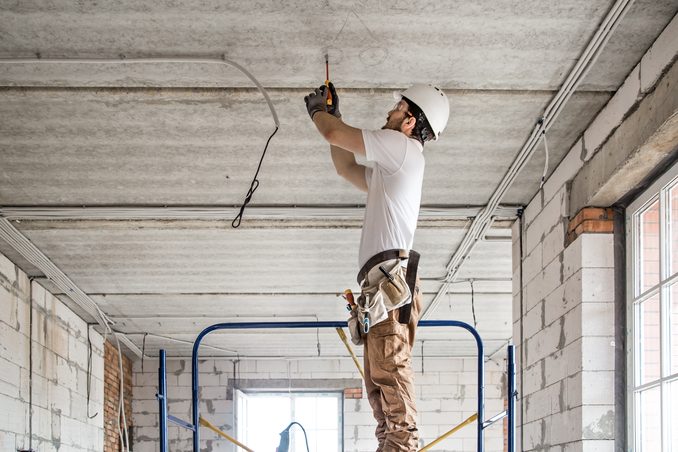

Commercial property is the coverage that answers for the things your electrical business owns and keeps in one place — the building you work out of, everything inside it, and the materials you stock. Where general liability answers for the harm your work can do to other people and their property, commercial property faces the other direction entirely: it protects your premises, your business personal property, and your inventory when a fire, a theft, or another covered peril hits the place you operate from.
For an electrical contractor that matters more than for most trades, for one reason: the materials you carry. The copper wire, panels, breakers, fixtures, and gear staged for the next job are valuable, portable, and a known theft target — an exposure a general-office business does not have. This page walks the building and premises, the business personal property inside, and the materials inventory that gives the trade its distinctive exposure; treats the fire at your own shop as the ownership line that separates property from general liability; covers loss of use if the shop goes down; and draws the second seam owners run into — the line between what stays at the premises and what travels to the job.
The building, your premises, and business personal property
The first thing commercial property answers for is the place you operate from. If you own the shop, warehouse, or office, the building itself is insured property. If you lease it — as many electrical contractors do — the coverage still matters, because the improvements and betterments you make to a leased space, and everything you bring into it, are yours to protect even when the walls are not.
Inside that footprint sits your business personal property — the movable things your business owns and keeps on site: benders and shop machinery, benches and shelving, the testing gear you store between jobs, spare parts, office furniture and computers, and the records the business runs on. A fire, a burst pipe that soaks a stockroom, storm damage, or a theft can take out a large share of what the operation depends on in one event, and commercial property is the line written to respond. Most policies are built around a building and business personal property structure — one part for the structure, one for the contents — though the wording, the covered perils, and the forms vary by carrier, and what matters is the coverage actually attached to your policy.
The materials inventory the trade carries — and copper theft
Here is where electrical work diverges from an ordinary office risk. The trade runs on copper wire and cable, panels, breakers, fixtures, and gear, and a working contractor keeps a meaningful amount of it on hand — staged for the next install, held between jobs, or bought ahead. That inventory is business personal property, and commercial property is where it is answered.
It is also a theft exposure that deserves plain treatment. Copper is valuable, portable, and hard to trace once it leaves your shop — which makes staged wire and panels a target, and a break-in that clears out inventory a loss electrical contractors plan around. We describe this honestly and without invented figures: the point is not a statistic, it is that your stock is both a real asset and a real target, and it needs to be insured to what you actually carry. How theft is covered — the limits, any sub-limit on stock, and the security conditions a carrier expects — depends on the policy wording, which is what we read against your real inventory before binding.
A fire at your own shop: the ownership line
This is the single most important line-drawing on the page, because it is the same peril on both sides — fire — and the seam owners get backwards most often. A fire in a building you wired, harming a structure and property that are not yours, is a general liability claim: third-party harm caused by your work. A fire — or a theft — at your own shop, warehouse, office, or the copper and materials inventory you own is a commercial property claim. The line is not the peril; it is ownership: whose building burned.
Get that backwards and the gap shows up at the worst moment. A contractor who assumes the general liability policy every general contractor asks to see will also answer for a fire that guts their own shop is carrying a false sense of security: general liability is built to answer for other people, not for the insured’s own premises. The two are written and sold together, but they cover opposite sides of the ownership line — and drawing that line before a loss is the whole reason this page exists.
If the shop goes down: business income and extra expense
Property is not only about the physical building and stock — it is also about what happens to the operation when the location is out of commission. If a covered loss such as a fire makes your premises unusable, business income coverage can respond to the income the business loses while it is down, and extra expense can respond to the added cost of keeping crews working through it — a temporary location, expedited replacement of the gear and inventory you need to keep jobs moving, or the cost of operating in a degraded state until you are back.
How much this matters depends on how tied the operation is to the location — how much inventory, shop equipment, and back-office capacity lives there versus in the field. For a contractor whose crews mostly work out of trucks, the field keeps moving; for one who runs fabrication or prefab from the shop, a shutdown bites harder. We size it to that reality rather than to a stock default.
What stays versus what travels: the equipment seam
The second line owners run into is not about the peril either — it is about location. Commercial property is built around a fixed premises and the things kept there. The tools of the trade that travel — the testers, meters, benders, wire spools, and lifts that ride to the jobsite and back, and the material staged in the field or in the truck — are answered by contractors equipment instead, an inland marine line written for tools and materials on the jobsite and in transit.
That split is deliberate, not a gap. Commercial property covers what stays — the building, the premises, the stored inventory; contractors equipment covers what travels. When a lift is damaged on a job or testers are stolen off a truck, that is contractors equipment; when a fire takes the shop and the copper stacked in it, that is commercial property. The two hand off cleanly at the premises line, and reading them together so nothing falls between them is part of building the program.
What commercial property responds to
These are the categories underwriters expect on an electrical commercial property file. They are described qualitatively and with generic carrier language — every claim is handled by the carrier, never named here — with no fabricated cost or frequency figures.
- The building and improvements. The shop, warehouse, or office you own, or the improvements and betterments you make to a space you lease, damaged by a covered peril such as fire.
- Business personal property. The movable contents your business owns and keeps on site — shop machinery, benders, benches, shelving, stored testing gear, office equipment, and records.
- Materials inventory, including theft. The copper wire, panels, breakers, fixtures, and gear you stock, against covered perils and against theft from your premises — the exposure that makes the electrical trade distinct.
- Business income and extra expense. The income lost and the added cost of operating while a covered loss keeps your premises out of use.
- Fire and theft at your own premises. The own-side of the ownership line — your building and your stock — as distinct from third-party fire damage, which is general liability.
Why electrical contractors need it
An electrical business does not run out of a laptop. It runs out of a shop stacked with copper, panels, and gear; it depends on the fabrication, storage, and staging that location provides; and the inventory on its shelves is both valuable and a theft target in a way few trades share. A single fire or a single break-in can take out a large share of what the operation is built on — and none of that is answered by the general liability policy every general contractor asks to see, because that policy faces outward at third parties, not inward at your own premises.
Because the exposure differs by the electrical work you do, the property program has to fit the operation. A Residential Electrical contractor may run a modest shop and a truck-based crew, with inventory that turns quickly. A Commercial & Industrial Electrical contractor often carries heavier inventory, prefab space, and larger staged material for new-construction and systems work. A Power Line Contractor contractor holds specialized stock and gear for utility-scale work. We rate the building, contents, and inventory to the real operation, not to a stock number that under-insures the copper on the shelf.
Limits and structure
Commercial property is usually written with separate limits for the building and for business personal property, often on a replacement-cost basis, with the materials inventory valued to what you actually stock. For an electrical contractor the piece to watch is that inventory limit — the copper and gear on hand — because a default set for a generic office will not reflect a shop full of wire and panels. Business income and extra expense ride on top, sized to how dependent the operation is on the location. Rather than quote a stock figure, we read the building, contents, and inventory against the coverage before binding. The tools that travel to the job are handled on a separate contractors equipment line, and the harm your work does to others by fire by general liability.
Why Electrical Guard Insurance
We are an independent agency that writes one class — electrical contractors — and we place coverage with carriers that actually want the work. That focus is the point on property. We know to ask how much copper and inventory you carry before we set a contents limit; to insure the materials on your shelves against theft to what you actually stock; to draw the ownership seam so a fire at your own shop is answered rather than assumed to sit under general liability; and to hand the traveling tools cleanly to contractors equipment so nothing falls between the two lines. Start with a quote, or talk it through with us first.
Learn more
Coverage for an electrical business works as a system. Commercial property pairs most often with general liability for the third-party harm your work can cause — the fire in a building you wired — contractors equipment for the testers, gear, and material that travel to the job, commercial auto for the service and bucket trucks, workers compensation for the crew and its electrocution and arc-flash severity, professional liability for design-build and consulting work, and umbrella liability when an account demands limits above your primary layer. How it is written also differs by the electrical work you do across the three service pillars — Residential Electrical Insurance, Commercial & Industrial Electrical Insurance, and Power Line Contractor Insurance.
Coverage for electrical contractors
- General Liability Insurance
- Workers Compensation Insurance
- Commercial Auto Insurance
- Contractors Equipment Insurance
- Umbrella Liability Insurance
- Professional Liability Insurance
Insurance by the electrical work you do
- Residential Electrical Insurance
- Commercial & Industrial Electrical Insurance
- Power Line Contractor Insurance
Get covered
Primary sources
Frequently asked questions about Commercial Property Insurance
What does commercial property insurance cover for an electrical contractor?
Commercial property answers for the things your electrical business owns and keeps at a fixed location — the shop, warehouse, or office building if you own it (and your improvements if you lease it), and the business personal property inside: benders, work benches, shelving, testing gear kept on site, office equipment, and the materials inventory you stock. For the electrical trade that inventory is a real exposure of its own — the copper wire, panels, breakers, fixtures, and gear staged for the next job, which is both valuable and a target for theft. It responds to perils such as fire, and to theft, at your own premises. What it does not answer is harm to a THIRD party — a fire in a building you wired that damages property that is not yours is general liability — or the tools and testers that travel to the jobsite, which are contractors equipment. It covers what stays and what you own.
Is my copper wire and materials inventory covered against theft?
The materials inventory an electrical contractor stocks — copper wire and cable, panels, breakers, fixtures, and gear — is business personal property, and commercial property is the line built to answer for it, including theft from your premises. Copper in particular is a real target: it is valuable, portable, and hard to trace, and a break-in that clears out staged wire and gear is a loss electrical shops know. How theft is covered depends on the wording actually attached to your policy — limits, any sub-limits on stock, and the security conditions a carrier expects — which is exactly what we read against the inventory you actually carry before binding, rather than assume. Material in transit or staged on a jobsite, rather than at your premises, is usually answered under contractors equipment instead.
Is a fire at my own shop covered by general liability or commercial property?
Commercial property — and this is the seam electrical owners most often get backwards, because it is the same peril on both sides: fire. A fire in a building you WIRED, harming property that is not yours, is a general liability claim. A fire — or a theft — at your OWN shop, warehouse, office, or the copper and materials inventory you own is a commercial property claim. The line is not the peril; it is ownership: whose building burned. General liability answers the third-party harm your work can cause; commercial property answers your own building and stock. An electrical contractor who assumes general liability covers their own premises finds the gap during a loss, which is why we draw the line explicitly before one happens.
Are my tools, testers, and lifts covered under commercial property?
Only while they stay at the premises the policy schedules. The clean way to think about it is what stays versus what travels: commercial property covers the building, the premises, and the stored inventory — the things that stay put. The testers, meters, benders, wire spools, and lifts that travel to the jobsite and back, and that get damaged or stolen away from your shop, are covered under contractors equipment, an inland marine line built for tools and materials on the jobsite and in transit. The two lines fit together, but they answer different property in different places, and getting that split right is part of building the program.
What happens if my shop is shut down after a fire?
That is what business income and extra expense coverage is for, and it usually rides on the commercial property policy. If a covered loss such as a fire makes your shop, warehouse, or office unusable, business income can respond to the income the business loses while it is down, and extra expense can respond to the added cost of keeping the operation running — a temporary location, or the cost of replacing the gear and inventory you need to keep crews working. Whether it applies, and to what limit and waiting period, depends on the coverage actually attached to your policy. We size it to how dependent your operation is on the physical location.
Does commercial property cover my materials while in transit or on a jobsite?
Usually not — that is the edge of the property line. Commercial property is built around a fixed location and the things kept there; once your copper, panels, gear, and tools leave the shop and move to a jobsite or ride in the truck, the exposure is typically answered by contractors equipment and installation coverage on the inland marine side instead. That is a deliberate split, not a gap: the two lines are written to hand off at the property line — what stays at the premises to commercial property, what travels to contractors equipment — and reading them together so nothing falls between them is exactly the work we do before binding.
Get commercial property built around the shop and the copper in it
Tell us whether you run residential service, commercial and industrial systems, or power-line work, and how much inventory you carry, and we will market it to carriers that write the class — with the building, your stock, and the theft exposure insured to what you actually hold.