

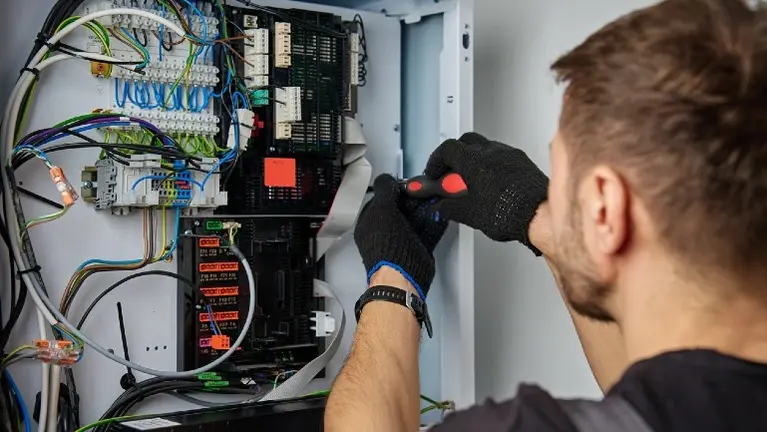
An electrician who rents a shop usually insures everything inside it that the business owns or improved, while the landlord insures the building itself. The lease decides the details, including the liability limits you must carry and who waives what, so the right property program starts with reading the lease’s insurance section before you sign it.
What does the landlord insure, and what do you insure?
In a typical commercial lease, the landlord insures the building structure and the tenant insures its own property and its own liability. For an electrical contractor, “its own property” is a long list: tools and test gear kept at the shop, wire and fixture inventory, office equipment, shelving and racks, and any improvements the business paid to install. None of that is protected by the landlord’s building policy simply because it sits inside the landlord’s walls.
The split is not universal, which is why the lease matters. Some leases make the tenant responsible for insuring parts of the building, such as the storefront glass, the overhead doors or the space it occupies in a multi-tenant building. Others assign responsibility for the building’s systems. Read the lease’s insurance and repair sections side by side, and ask your agent to confirm each responsibility is covered. The property coverage page explains how property insurance is structured for electrical contractors.
Why are tenant improvements easy to leave uninsured?
Because they become part of the building, and everyone assumes someone else insured them. An electrical contractor that rents a bare unit and builds out an office, adds a mezzanine for storage, upgrades the lighting or installs its own service has invested in the landlord’s building. After a fire, the landlord’s policy may rebuild the shell, but it may not restore the improvements the tenant paid for.
The fix is to name tenant improvements and betterments on your own property policy and to value them at what it would cost to replace them. Electrical contractors are especially prone to this gap, because they tend to do their own build-out work and rarely think of their own labor and materials as something to insure. Make a list of what you added to the space, and give it to your agent with the lease.
What should the property policy cover inside a rented shop?
Everything the business owns or is responsible for, at values that would let it restart. That usually means business personal property for the furniture, fixtures, office equipment and inventory, and improvements and betterments for the build-out. Tools and test gear that travel to jobsites are usually better insured on contractors equipment, which follows them off premises, while tools that stay at the shop can sit on either policy depending on how the program is set up.
Copper and wire inventory deserves its own attention, because it is a target for theft and its value moves. Our post on copper theft and electrical property coverage covers how theft terms, security requirements and inventory values affect that coverage. For comparing property offers once you know what to insure, our post on commercial property insurance for electrical contractors walks through the comparison line by line.
What liability insurance does a shop lease usually require?
Most commercial leases require the tenant to carry general liability at stated limits, to name the landlord as an additional insured and to deliver a certificate before taking possession. Some also ask for limits above the primary policy, which is one of the triggers covered in our post on when an electrical contractor needs umbrella liability.
The additional insured request deserves a careful read. It extends some of your liability coverage to the landlord for claims arising from your use of the premises, and the endorsement your policy uses decides how far that extension goes. Our post on additional insured for electricians explains what the endorsement does. Give the lease to your agent so the certificate and the endorsement match the wording the landlord expects.
What does a waiver of subrogation in a lease do?
It stops one party’s insurer from pursuing the other after a loss. Without a waiver, if a fire starts in your unit and the landlord’s insurer pays to rebuild the building, that insurer may try to recover from you. With a mutual waiver, each party relies on its own insurance, and neither insurer pursues the other side.
Waivers are common in commercial leases, and they are generally a good arrangement for both sides, but they have to be allowed by both policies. Your agent should confirm that your property and liability policies permit the waiver the lease requires, and that the waiver runs in both directions if the lease says it does. A waiver your policy does not allow can create a coverage problem at exactly the wrong time.
Why does business income coverage matter to a tenant?
Because a fire in a rented shop can stop the business while the bills keep coming. The lease may require rent to continue, payroll still has to be met, and jobs scheduled for the coming weeks still need crews, tools and materials. Business income coverage can replace lost income and pay continuing expenses while the business recovers, and extra expense coverage can pay for the cost of operating from a temporary space.
The questions to ask are practical. How long would it take to find and fit out a new shop? Could the crews keep working from trucks while that happens? Is there a backup place to store inventory and park vehicles? The answers tell your agent how much business income coverage the business needs and how long it should run.
Real-World Scenario: An electrical contractor rents a unit in a light industrial building and spends its own labor building an office, adding racking and upgrading the lighting. A fire in the next unit spreads, and the landlord’s insurer rebuilds the shell. The contractor’s policy covers its tools and inventory, but the build-out was never listed, and the lease says the tenant is responsible for its own improvements. Listing the improvements on the property policy when the build-out was finished would have closed the gap.
What should you do before signing a shop lease?
Send the lease to your agent before you sign it. Ask for the insurance section to be read against the policies you have now, and get a list of what needs to change: limits to raise, endorsements to add, improvements to schedule and waivers to confirm. Small changes to the lease wording can be easier to negotiate before signing than after.
If you are moving into your first shop, our post on how to start an electrical business covers the wider set of steps, and questions about insurance rules in your state can go to your state insurance department through the NAIC directory of state insurance departments.
What should your insurer know about how you use the shop?
More than the address. An electrical contractor’s shop can be an office with a few shelves of parts, or it can be a working space where crews prefabricate assemblies, cut and bend conduit, charge tool batteries and stage material for several jobs at once. Each of those activities changes the property and liability picture, and the policy should describe what actually happens in the space.
Tell your agent who visits the shop, whether customers or suppliers come and go, how the space is secured after hours and whether vehicles are parked inside or in a yard. Security details such as alarms and locked storage for wire can affect how theft coverage applies. A description that matches the real use of the shop is what keeps a claim straightforward.
What changes when you move or expand?
Moving shops resets the analysis. A new lease brings new insurance terms, a new building brings new values and a new location may change the property and liability rating. Tell your agent about the move before it happens, so coverage is in place at the new address on the day you take possession and does not lapse at the old address before you leave.
Expansion is similar. Adding a yard for trucks and material storage, a second unit or a separate warehouse adds locations that must be listed on the policies. A location that is not listed may not be covered, and outdoor storage in a yard can carry its own terms.
What is the next step?
Send your lease, a list of your improvements and a description of what you keep at the shop with a quote request. We read the lease first, then set your property and liability coverage to match it. The coverage overview shows how each line fits.