
The same fire can land on two entirely different policies, and ownership is what decides which one answers. A fire in a building that is not yours — a customer’s, a general contractor’s, a tenant’s — started by your electrical work is general liability. A fire at your own shop, warehouse, office, or the materials you own is commercial property. Same peril, two policies, split by who owned what burned.
The short version: general liability answers the third-party harm your work causes, so a fire in someone else’s building runs there; commercial property answers your own premises and the stock you keep, so a fire at your own shop runs there. Same peril, opposite sides of one line — ownership. Those two pages own the coverage architecture; this post is about the line itself, and why it is the seam electrical owners get backwards more than any other.
One fire, two policies — the ownership line
Most coverage questions start with the peril: what went wrong, and does a policy answer for it. Fire is unusual because the peril alone does not tell you which policy responds. Two electrical fires can look identical — the same overheated connection, the same wall, the same smoke — and route to two different policies. What separates them is not the fire. It is who owned the thing that burned.
That is the ownership line, and it runs straight through the middle of an electrical contractor’s program. On one side sits everyone else’s property: the buildings you wire, the tenants and occupants inside them, the general contractor’s project, the customer whose finished space your work is part of. Harm to any of that is third-party harm, and it runs through general liability. On the other side sits your own property: the shop or warehouse you operate out of, the office, the business personal property inside, and the materials you stock. A loss to any of that is a first-party loss, and it runs through commercial property.
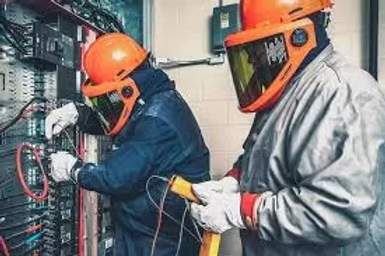
The reason to slow down on this is that fire is the electrical trade’s defining peril, and it is precisely the peril that crosses the line in both directions. An electrical contractor is more exposed to fire than almost any other business — both to causing one in a building that is not theirs, and to suffering one at their own premises where copper and gear are stacked. When the same peril sits on both sides of the ownership line, the line is the only thing keeping the two claims straight.
Whose property burned? The line at a glance
The cleanest way to read the seam is to ask one question the moment there is a fire: whose building burned. Everything else follows from the answer. If the structure and the contents that burned belong to someone else, it is a third-party claim and general liability is the policy in play. If they belong to you, it is a first-party claim and commercial property is the policy in play. The diagram below is that single question, drawn.
Why electrical owners get this seam backwards
The reason this line trips electrical contractors specifically comes down to which policy they think about most. General liability is the policy a contractor lives with day to day: every general contractor asks to see it, every certificate request references it, every project contract is built around it. It is the visible, constantly requested coverage — the one an owner grows used to thinking of as the policy that answers when something burns.
So when a fire hits their own shop, the instinct is to reach for the policy they know best. But general liability is built to answer for other people, not for the insured’s own premises. It faces outward by design. A contractor who assumes the general liability policy everyone asks to see will also make them whole after a fire at their own building is carrying a false sense of security straight into the loss, because the policy was never pointed in that direction.
The mirror-image mistake happens less often but is just as costly: assuming commercial property will answer for a fire in a building the crew wired. It will not. Commercial property never reaches a structure the contractor does not own. The building that burned belonged to the customer, so the harm is third-party harm, and it routes to the completed-operations side of general liability — the tail this brand’s general liability page is built around. Each policy answers exactly one side of the ownership line, and neither one crosses it to cover for the other.
Two policies, bought separately
The practical consequence of the ownership line is that an electrical contractor needs both policies, and they are bought separately. General liability and commercial property are distinct lines with distinct forms, distinct limits, and distinct triggers. One protects the third parties and the buildings your work can harm; the other protects the place you work out of and the stock you keep there. They are written and sold alongside each other, but they are not one policy, and carrying one does not quietly include the other.
This is where the gap opens. An electrical contractor focused on winning work buys the general liability every job demands and moves on — and the shop, the office, and the copper stacked in the back can go uninsured against the very peril the trade is most exposed to. The gap does not announce itself. It sits quietly until a fire at the premises turns an assumed coverage into an uncovered loss. The honest move is to read both sides of the ownership line against your actual operation before a loss forces the question, so the first-party side that protects your own building is in place alongside the third-party side every general contractor already made you carry.
Real-World Scenario: An electrical contractor runs a tenant build-out and, months after energizing the panel, a connection overheats and starts a fire that guts the tenant’s space. That building is not the contractor’s, so the third-party damage routes to the completed-operations side of general liability. A season later, a fire of a different origin sweeps through the contractor’s own shop overnight, taking the building and a stockroom full of copper and panels. Nothing about that second fire is a third-party loss — the building and the inventory are the contractor’s own, so it is a commercial property claim start to finish. Same peril, both times. Opposite sides of the ownership line, answered by two separate policies — and a contractor who carried only the first one would have watched the second fire become an out-of-pocket loss.
The ownership line runs past fire, too
Fire is the sharpest illustration of the ownership line because it crosses in both directions, but the same principle sorts other losses too. Theft is a first-party loss: the copper wire, panels, and materials an electrical shop stocks are the contractor’s own property, so a break-in that clears out staged inventory runs through commercial property, where the trade’s copper and materials theft exposure is answered. It never touches general liability, because nothing about a stolen spool of your own wire harms a third party.
Running the other direction, the completed-operations fire — the connection or panel you leave behind that ignites in a finished building long after the job — is a third-party loss that the general liability page and the additional-insured post both treat in depth. The point here is not to re-explain either exposure, but to show that once you hold the ownership line in your head, the whole program sorts itself: your own property routes one way, other people’s property routes the other, and the peril — fire, theft, or anything else — is never the thing that decides.
Draw the line before the loss
The takeaway is one question worth memorizing: whose property burned. A fire in a building that is not yours, started by your electrical work, is general liability; a fire at your own shop, warehouse, office, or in the copper and materials you own is commercial property. The two are bought separately and answer opposite sides of one line, and the side an electrical contractor most often leaves open is their own premises — because the policy everyone asks them to carry was never built to point that way. Coverage depends on your specific policies and how they are written, so it is worth reading both sides against your operation rather than assuming one covers the other. When you are ready, start a quote and tell us where your crews work and what you keep at the shop, read the general liability and commercial property pages to see how each side of the line works, or browse the coverage overview to see where every line sits.