

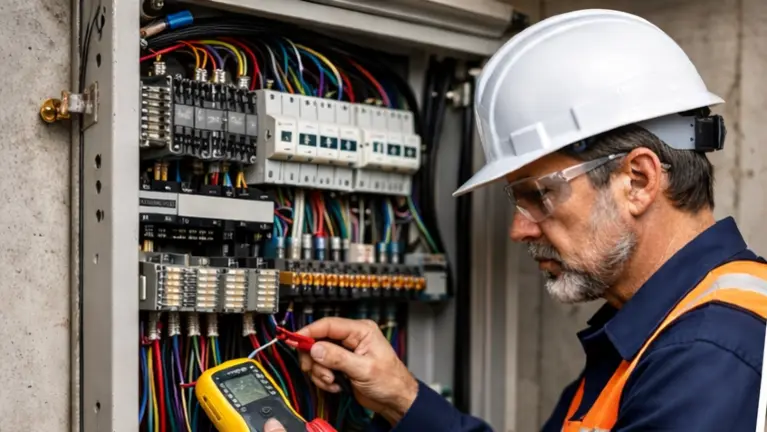
There is no published price for electrical contractor insurance in South Dakota, and any number quoted before an underwriter has seen your crew is a guess. What a carrier actually does is build the cost from your specific operation — your payroll and the energized work it covers, the panels and connections you leave behind, your claims record, and the coverage you carry. This guide walks the drivers that decide what a South Dakota electrical contractor pays.
South Dakota is worth opening on geography, because where the work is shapes this trade’s cost as much as what the work is. A large share of the state’s electrical service runs across rural feeders and small towns spread over open country — long drives, remote sites, and line-adjacent work — and a carrier reads that footprint closely. Below is what moves the number for a South Dakota electrical operation, in roughly the order it matters, and what you can do about each. For the market and regulatory overview behind these drivers, see our South Dakota electrical contractor insurance page — this cost guide is its companion.
Rural feeders, small towns, and where the work actually is
Start with the shape of the book, because in South Dakota it is distinctive. Beyond the Sioux Falls and Rapid City metros, much of the service and line-adjacent work reaches rural feeders, farmsteads, and small towns spread across open country, so crews travel long distances and often work far from the nearest supply house. That geography does two things to your cost. It raises the profile of your commercial auto and contractors’ equipment lines, because the vans, bucket trucks, and tools log more road miles and sit at remote sites. And it concentrates line-adjacent and restoration work — the higher-severity end of the trade — so a carrier reads the geography of your book alongside the work itself. Describing where you actually work is part of describing your operation accurately.
Crew payroll and the injury profile a carrier reads
Payroll is usually the single biggest driver for an electrical contractor, because it scales both your workers compensation and a large part of your general liability. It is not just the size of the payroll — it is which work it covers. Electrical work carries genuine injury severity, for plain reasons: crews work on energized equipment, face arc-flash and electrocution hazards, and climb and work at height, which is why the Occupational Safety and Health Administration treats electrical safety as a defining regime and why the industry works to the NFPA 70E arc-flash standard. South Dakota places comp in the private market, so a carrier reads your crew’s safety discipline as closely as its size, and your classifications and employers-liability sizing both feed the number. On a basis built from class codes, how your payroll divides across service, new-construction, and any line work decides which hazard the payroll behind it is rated against. Employers liability, the second half of a comp policy, answers the injury suits that fall outside the comp bargain, and on an electrocution- and arc-flash-exposed crew a carrier sizes it deliberately.
Revenue and the completed-operations fire tail — the work you leave behind
Your revenue is a rating basis for general liability, but for an electrical contractor the exposure that defines the class is completed operations. A panel, connection, or circuit keeps energizing after your crew is gone, and a loose termination or latent fault can overheat and start a fire weeks or months after the job closes, becoming a serious third-party property-damage claim. The completed-operations side of general liability is the signature line built to answer for it, and because installed electrical work carries such a long tail, your revenue and your workmanship-and-inspection record are inputs a carrier weighs closely. This is the electrical contractor’s defining cost driver — the thing that separates finished electrical work from trades that leave nothing energized behind. In practice a carrier watches the products-completed-operations aggregate on your general liability closely, because that is the limit reserved for the fire tail; a South Dakota book with heavy installed revenue may need that aggregate set above the per-occurrence limit, and matching it to your finished work is part of an accurate program.
South Dakota’s state license and your labor mix
South Dakota licenses electricians statewide through the South Dakota Electrical Commission, which runs a registered-apprentice, journeyman, and electrical-contractor ladder built on documented on-the-job hours. That structure is a cost input in a way owners often miss: the mix of apprentice, journeyman, and master-level labor on your crews shapes both your payroll composition and the risk profile a carrier reads, because supervised, credentialed work tends to correlate with the workmanship quality that limits completed-operations claims. On a book that runs a lot of remote, line-adjacent work, that supervision matters. The ladder is a labor-cost shaper, not a premium line, but it is part of the picture a carrier builds.
Real-World Scenario: A Sioux Falls service-and-remodel electrician runs panel upgrades and rewires in occupied homes across the metro, while a Rapid City power-line contractor runs restoration and feeder work across the western ranchland after a summer storm. Both leave finished electrical work behind that has to hold for years, but the underwriter reads them differently — the residential crew’s exposure rides the completed-operations fire tail in finished homes, the power-line contractor’s on arc-flash and electrocution severity, long travel, and larger-contract limits. Same South Dakota, same electrical class — but the work mix prices differently.
Prairie storms, wind, and winter across the state
South Dakota’s weather adds a second stamp to the cost picture. Electricians face severe summer storms on the eastern prairie, high winds and heavy snow across the winter, and the outages both bring. For an electrical contractor that shapes cost in two ways. It drives demand — storm rebuild, service-upgrade, and cold-weather work follows the weather, and a carrier reads the revenue behind it. And energized restoration under time pressure concentrates loss activity, so your claims history — how the work you left behind performed and how your crew handled live gear — is a driver a carrier weighs. A clean record on a storm-exposed book is worth more than a headline rate.
Service, commercial, and power-line — the work-mix driver
The kind of electrical work you do moves the number as much as how much you do. A residential electrical service and remodel operation carries a completed-operations fire profile driven by panel upgrades, rewires, and fixture work in occupied, finished homes. A commercial and industrial contractor carries a different signature: larger systems, additional-insured and higher-limit contract demands, and design-build professional exposure. And a power-line contractor sits at the severe end — energized line work, bucket-truck fleets, and the arc-flash and electrocution severity that make it among the highest-rated classes there is. Same trade, genuinely different cost conversations, which is why a carrier wants your work mix before it prices anything.
Professional liability and the design-build exposure
For the South Dakota contractors who design as well as install — the commercial, agricultural, and industrial shops that engineer a system rather than wire to another firm’s drawings — professional liability is the seventh line, and it answers a gap the others leave open. A load-calculation, specification, or design error that later causes a loss is a financial claim, and the bodily-injury-and-property-damage trigger on general liability does not reach it. A contractor bidding design-build work across the Sioux Falls and Rapid City markets, and on the ag and industrial build work spread across the state, carries this exposure whether or not it buys the coverage, so a carrier reads the design content of your book as its own driver. Where your work is wire-to-plans only, the exposure is lighter; where you engineer, it is real.
Trucks, equipment, copper, and the coverage stack
Beyond the crew and the completed work, a carrier prices what you drive, what you own, and how your program is built — and on a rural-heavy book that stack matters. Commercial auto grows with your rolling stock and road miles; contractors’ equipment tracks the tools that ride to remote jobsites. And the electrical stack itself is a driver story: this trade carries a full set of lines because commercial property answers for the shop, warehouse, and the copper, panels, and materials staged inside it — a real theft-and-damage exposure. Whether you carry the products-completed-operations aggregate your revenue calls for, schedule your equipment to value, add the umbrella limits a contract demands, and set your limits to your contracts all feed the number. The full coverage overview shows how each line fits together.
How to get an accurate South Dakota quote
The path to a real number is to describe your real operation. Tell a broker your crew payroll and the work it covers, your revenue and the kind of electrical work you leave behind, how much of your book runs across rural feeders, your residential-versus-commercial-versus-power-line mix, your trucks and equipment values, your arc-flash and claims history, the limits your contracts require, and where in South Dakota you work — the market and its regulatory context sit with the South Dakota Division of Insurance. From there a carrier with genuine electrical appetite can price it. When you are ready, start a quote and tell us how your crews work, or see the South Dakota electrical contractor insurance page for the market picture behind these drivers. The number at the end will reflect your business, which is the only number worth having.